
High-frequency wafer probing has long been dominated by imported probes with long lead times and premium pricing. The XJTU-RFsatellite Probe series takes a different path: developed over five years by a Xi'an Jiaotong University team supported by two National Natural Science Foundation projects and a national youth talent program, with an invention patent granted, the series adopts a multi-material micro-additive manufacturing process to cover DC–145 GHz and 75–400 GHz waveguide bands.
Verified performance against commercial benchmarks
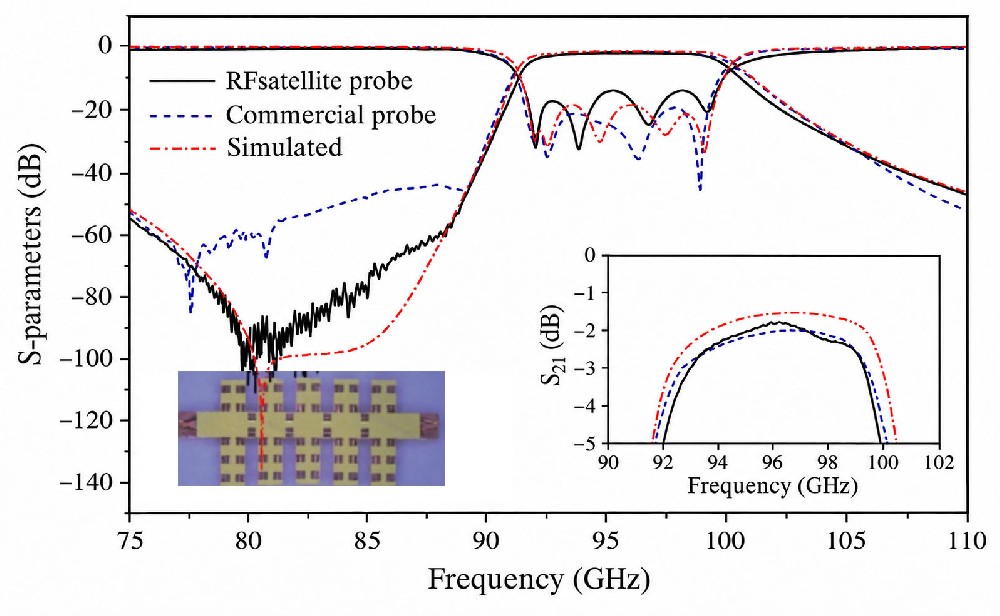
Measured S-parameters of the 75–110 GHz probe track both simulation and commercial-probe measurements across the band. Representative figures include crosstalk of −36 dB @ 92.5 GHz (75-110-GSG-125), −32 dB @ 140 GHz (110-170-GSG-100) and −43 dB @ 275 GHz (220-330-GSG-50), with typical return loss of 15 dB and insertion loss from 1.2 dB to 3 dB depending on band. Core RF indicators are comparable to commercial standards after strict testing.
A wide and growing frequency portfolio
| Probe | Band | Pitch | Typical insertion loss |
|---|---|---|---|
| 75-110-GSG-125 | 75–110 GHz | 125 µm | 1.2 dB |
| 110-170-GSG-100 | 110–170 GHz | 100 µm | 1.5 dB |
| 140-220-GSG-75 | 140–220 GHz | 75 µm | 2.5 dB |
| 170-260-GSG-75 | 170–260 GHz | 75 µm | 3 dB |
| 220-330-GSG-50 | 220–330 GHz | 50 µm | 3 dB |
| DC-110-GSG-125 | DC–110 GHz | 125 µm | 1.5 dB |
DC-family coaxial probes reach DC–145 GHz and DC–220 GHz (GSG, GSGSG and GSSG tip configurations, 1.0/0.8 mm connectors), and waveguide coverage extends to 260–400 GHz and 330–500 GHz in current trials.
Built for real probe-station work
The copper shell and 30° tip angle are chosen for mechanical durability; probes are rated for more than 50,000 touchdowns and operate from −45 °C to +85 °C. Fine visualization-optimized tips leave small marks with little device damage and penetrate oxide pads reliably. The probes are compatible with universal calibration components and standard SOLT and TRL calibration flows, and support passive devices, active chips and on-chip antennas.
Differential, dual-band and cryogenic options
Four-port differential probes (GSGSG/GSSG) serve 75–330 GHz with measured isolation below −30 dB. Waveguide-coaxial dual-band probes pair WR-5/WR-6 flanges with 1.0 mm connectors for DC–170 GHz and DC–220 GHz coverage through a single connection. Cryogenic-compatible waveguide probes are available for 75–260 GHz bands; their G/S contacts are DC-shorted without bias (no dielectric material) yet deliver exceptional mechanical performance.
The economics: lower cost, one-week service
Because 3D-printed structures replace precision-machined ones, the cost advantage is largest exactly where conventional probes are most expensive — 75 GHz and above. Domestic maintenance turnaround is about one week instead of an overseas round trip, and multi-port flexible expansion plus custom pitches (50–250 µm) let labs configure probes around the task instead of around the catalogue. The series fills a gap in the international market and has broken through foreign technological barriers in terahertz testing.
RFsatellite supplies the probe series for universities, research institutes and defense-electronics test benches. Send your frequency band, pitch size and calibration requirements through our project inquiry form — delivery time depends on band, pitch and test functionality, and our engineers will confirm a configuration and schedule for your bench.